
A truly memorable trip, catching up with an old friend and soaking up European and Asian influences in this remarkable country. June 2025.
The country of Georgia is positioned on the coast of the Black Sea. It lies between Russia to the north and Turkey, Armenia, and Azerbaijan to the south.
I flew from Birmingham to Istanbul and then onto Batumi, Georgia’s second city, where my friend relocated to several years back. The weather on arrival was very hot, even though the guidebooks had suggested a June average of circa 23-25 degrees. It was well over 30 degrees for most of my visit.
My friend’s flat had the most astonishing balcony views. One side provided vistas of the steep and heavily forested Adjara-Imereti mountains and the Black Sea port. The other side overlooked the rooftops of the historic French-style colonial old town, encircled by the most extraordinary modern architecture of high-rise hotels and commercial blocks, which would not look out of place in Dubai.
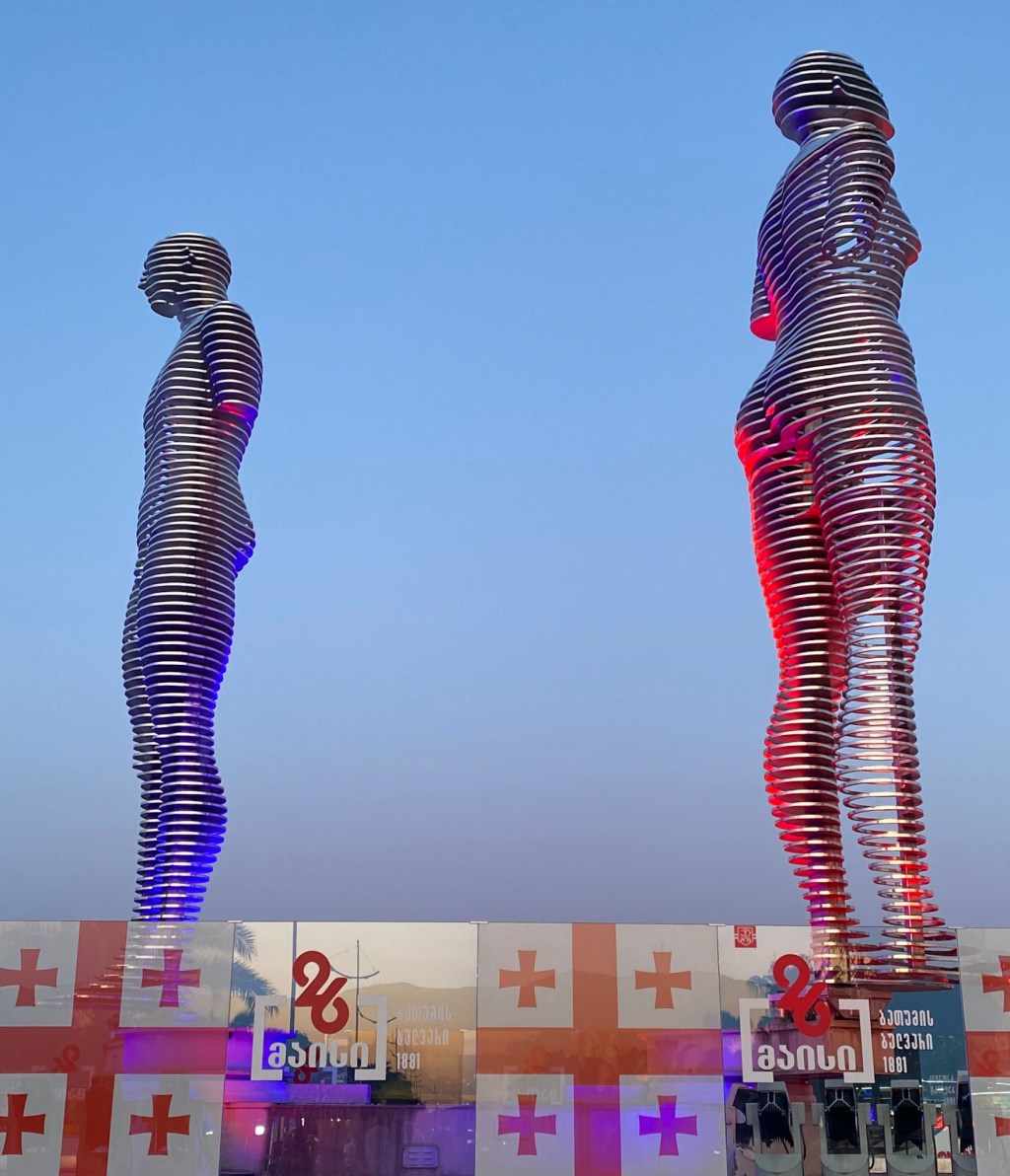
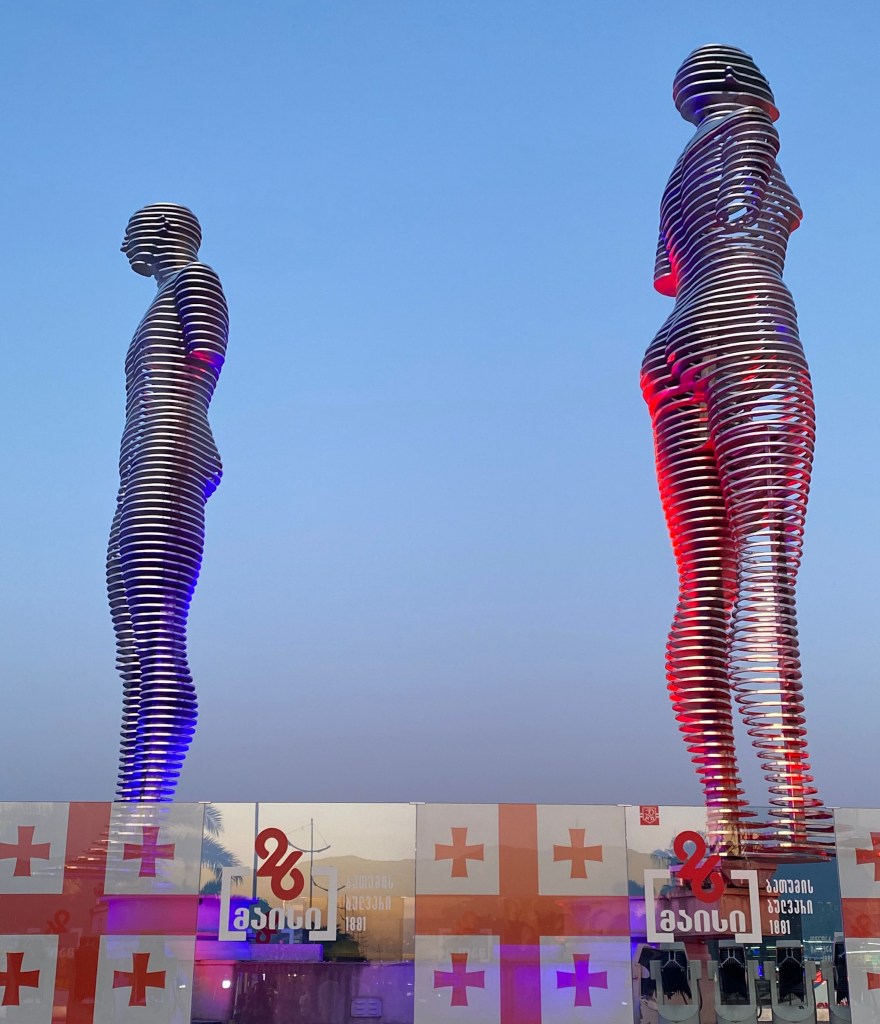
Relaxation that first night was followed by a morning walk along the impressive 7km seafront esplanade. At one end of the esplanade is a phenomenal eight-metre-high sculpture created by Georgian artist Tamara Kvesitadze. Originally called Man and Woman but now known locally as Ali and Nino inspired by a novel about a tragic love affair of the same name. The two figures are made from stacked metal segments, which move towards and away from each other. It is beautifully lit after sunset, and it is well worth spending the ten minutes it takes for the statues to move together to a short embrace and then move apart again. Many visitors will be aware of the Romeo and Juliet allegory to doomed romance.
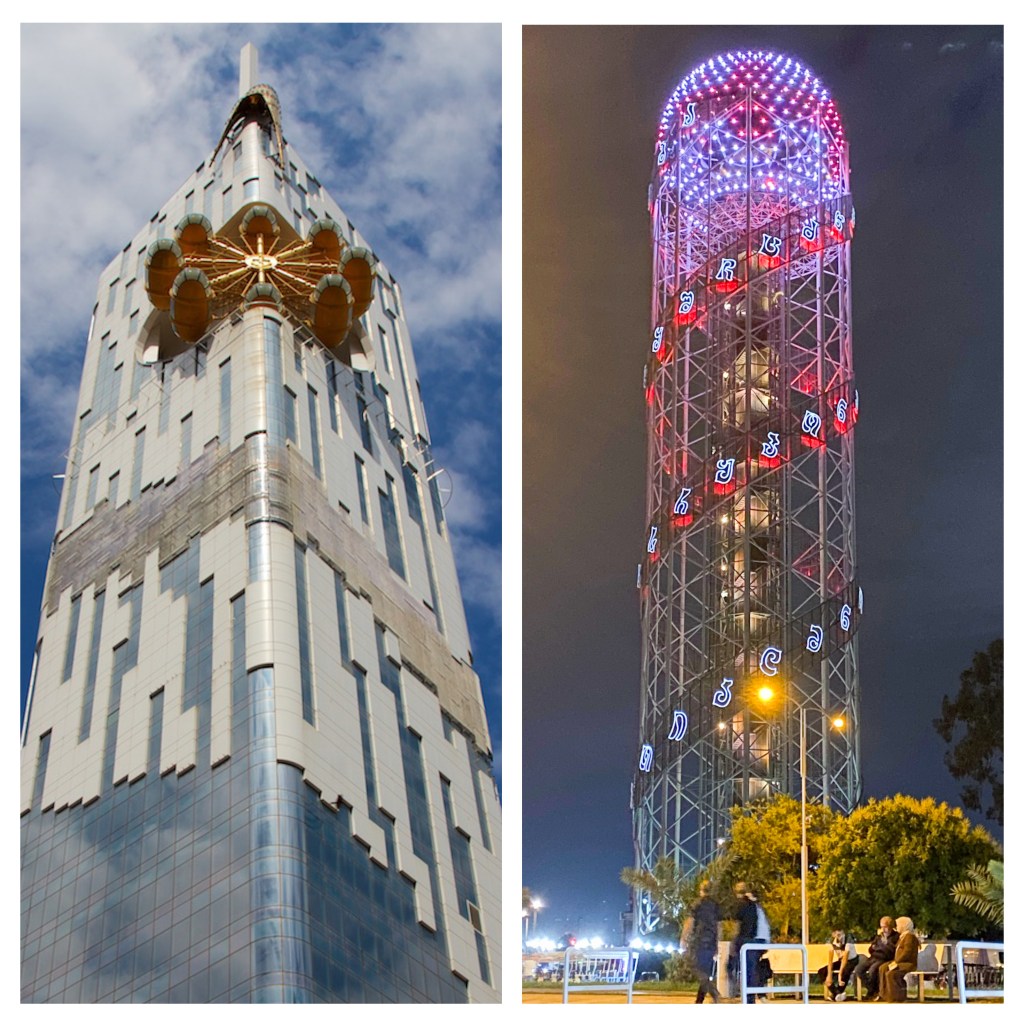
Close by is Alphabet Tower, another impressive tall building (130 metres), made up of two helix bands depicting the 33 letters of the unique Georgian alphabet. We visited the rooftop restaurant via the exposed bird’s-eye lift. The restaurant completely rotates every hour, and although we did not eat there, we were able to walk around and admire the amazing views over the sea, the mountains and the city.
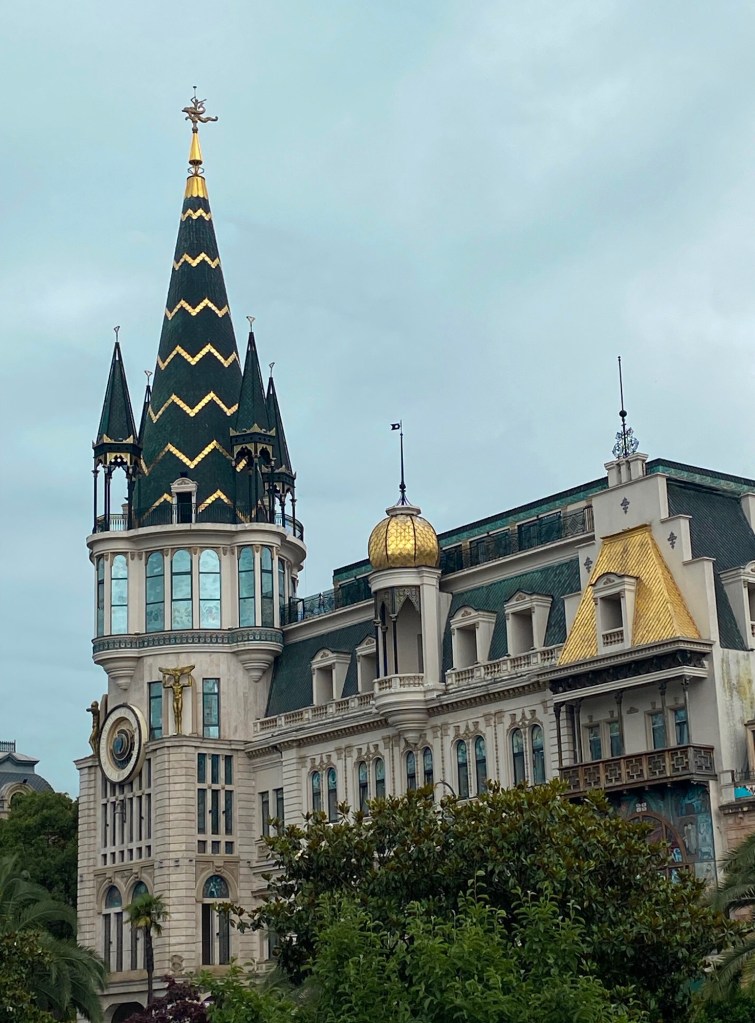
The other Batumi building I completely fell in love with was the pyramid style, modernist in design, Batumi Tower. The building hosts a non-operational Ferris wheel, which hangs 100 meters above ground. It is a unique and eye-catching structure, which opened in 2012, and was designed as an educational facility. The usage has been controversial, and it recently stood empty for two years. The tower has now been sold and repurposed. It is just a short hop from here to Europe Square – the main hub of Batumi – which is a great place for hanging out and admiring the architecture.
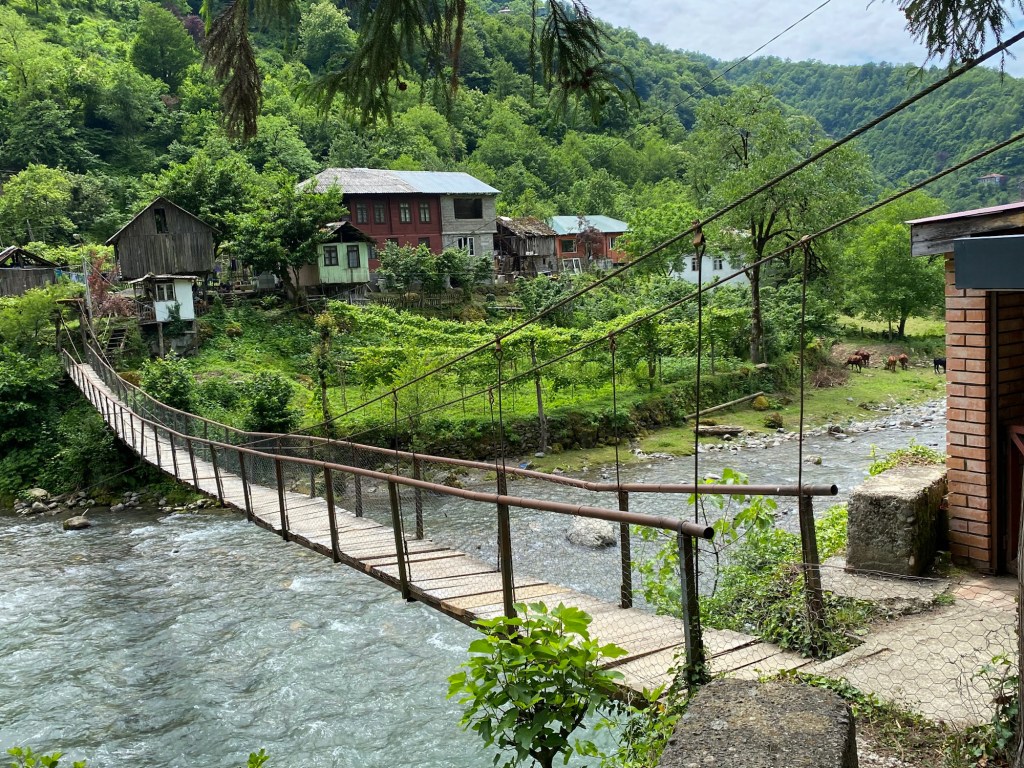
My friend organised a trip out towards Khelvachauri, a municipality of Batumi, about 8km from the city and into a different world of a very rural landscape of waterfalls and cows and pigs in the road. I was struck by the beauty of the Chorokhi River providing a restful setting for a lovely picnic lunch. We admired a number of magnificent waterfalls, wandered over rope bridges (very Nepal-like) and took photos of historic Queen Tomaras 12th century bridge. I was very conscious of the contrast between this peaceful, rural area with the lively city we had left behind at the beginning of the day.
I have no ear for languages and it took me a while to realise that my friend was speaking to locals in a Russian variant that bears little relationship to the Georgian Kartvelian vernacular. Georgia was part of Russia until 1991 and many older Georgians are embedded in their old ways. We noticed that some younger people were particularly keen to speak to us in English with a clear preference for their country to ally with Europe rather than their northern neighbours.
Although I had checked with the UK Foreign Office that visiting Georgia was safe, the advice stressed that terrorist attacks could not be ruled out and that political demonstrations in Tbilisi and other major cities should be avoided. There was, and still is, a warning against visiting the Russian occupied areas of South Ossetia and Abkhazia in the far north. Neither place was on my itinerary but there are evidently still live tensions dating back to the Russo-Georgian war of 2008.
Back to the delights of Batumi – a not to be missed experience is the Argo Cable Car – launching from the end of our street heading up the 256 metre Anuria Hill. It took 15 minutes to get to the top. There was a beautiful cool breeze when we reached the summit where there are various dining and drinking options with an exceptionally well laid out observation deck. It is reportedly very pretty in the evening. We walked back down via a well-defined path, taking in the stunning forest and vegetation whilst admiring the great views of the port and city below.
I was looking forward to visiting Yerevan in Armenia during my stay. When we investigated our options, we realised that it would take 24 hours by train from our Batumi base which we didn’t much fancy given the high temperatures. Instead, we decided to go to the Georgian capital Tbilisi – a much shorter 5 to 6-hour journey.
The railway system in Georgia is state owned and has been the subject of an extensive modernisation programme since 2004. There are at least two modern double decker air-conditioned trains running between Batumi and Tbilisi each day. The cost of a return train ticket worked out at between £20 and £45 depending on the class of travel.
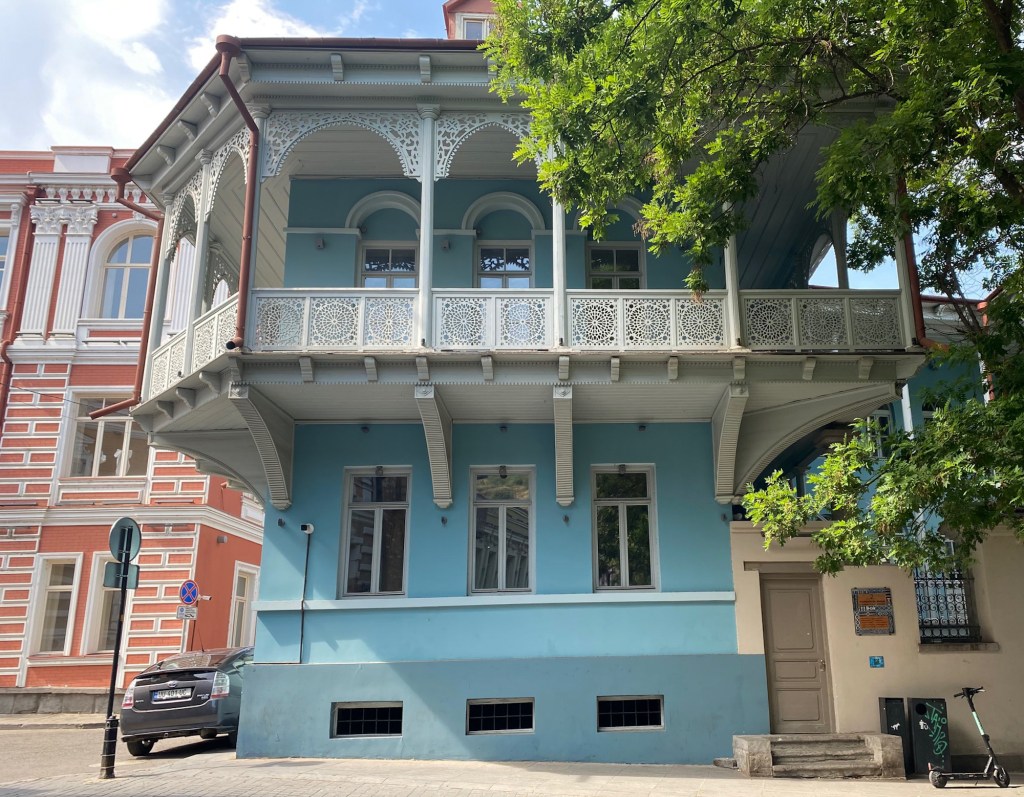
We stayed in a slightly dilapidated but characterful part of Tbilisi in a hotel called the British House, near to Rustaveli Avenue. After a late morning and brunch in a local cafe we headed out for the city and specifically the old town. We pottered around the charming and colourful streets, appreciating the newly renovated buildings around Freedom Square to the marketplace of Median, now full of souvenir shops. Walking along the narrow lanes in any direction from the main tourist traps brought us to more typical characterful homes, where building facades were reinforced by timber supports and washing lines prevailed in contrast to the sophistication of the gleaming streets around the corner.
After getting drenched in a massive, and unexpected, thunderstorm we took refuge in a bar and later walked up the hillside to the extensive and beautiful Tbilisi Botanical Gardens. We left the gardens about 8pm just avoiding being locked in, and just as a second thunderstorm arrived.
We managed to get tickets for Bizet’s Carmen opera at the Georgian National Opera theatre, one of the oldest opera houses in Eastern Europe. The foyer was somewhat functional in design but internally the theatre had a more classically oriental style across four or five different tiers. The opera was wonderful with a cast of about 50 members. The soloist playing the Carmen role was delightfully sensual, fiery and free – spirited. The ‘glamorous‘ bullfighter was played by a rather rotund gentleman who was instantly recognised by the audience, who leapt to their feet roaring with delight as he entered the stage. He played up to the swaggering matador role with panache and humour adding to the resounding energy of the opera and an unforgettable opera experience – and all for £19 per person!
The next day we went to a local Banya – which is a Russian style wood fired sauna, this one run by a copiously friendly Eastern European chap. The Banya was ultra smart and well organised with a wonderful aroma of eucalyptus, and it claimed to be the best Finnish sauna in Tbilisi! After sitting in the high humidity sauna for a short time the next step was the cold plunge bath, which reminded me of the wooden tub baths I once visited in Japan. The owner turned out to be the master of the oak brushes. This consisted of lots of light beating across my back with the oak twigs, whilst lying face down on eucalyptus leaves, followed by lots of pressing of said oak twigs. I was told it is the basis of Russian wellness culture. In all honesty, it was a supremely relaxing experience. We returned to the hotel and slept for nearly two hours.
Our final Tbilisi visit was the National Museum of Georgia – a whole section of which is dedicated to the 1912 Russian invasion – pretty grim but educational stuff. No wonder the young people do not want to speak Russian. There was a large demonstration we saw when returning to the hotel against the influence of Russia on the Georgian president and senior officials. I am not clear if the museum is currently (February 2026) open but is well worth a visit if possible.
We returned to Batumi by rail after our action filled four-days in the capital and I packed to return to the UK. It was a smooth journey back with no hiccups. I would definitely visit again and would recommend Batumi and Tbilisi in combination. Next time, building in a visit to Azerbaijan and/or Armenia would be a real plus for me. Watch this space.


 LONG TIME DEAD
Leave a comment